Showing posts with label bipap. Show all posts

27 July 2015

SLEEP STUFF: Cleaning gadgets and products for PAP users

Positive pressure airway (PAP) devices have revolutionized sleep apnea treatment. These devices include an air pressurizing machine with filters, a humidifying reservoir, tubing to deliver pressurized air and, of course, various kinds of masks to meet the various needs of patients.

Because the machines deliver therapeutic air pressure via devices that make constant contact with the face and airway, they require regular cleaning and care, not only so that they will work efficiently, but so they do not introduce foreign allergens and pathogens to the skin and airway, which can actually lead to health complications. Keeping them clean will help add longevity to their use so you don't need to replace them so often.

Unfortunately, not all users of PAP equipment understand the importance of keeping their gear clean and sanitized, and this results in poorer performance overall and side effects of usage that can be avoided. Don't think you need to clean your PAP gear regularly? Check out this article on what happens when you neglect to keep it clean.

Keeping your gear clean isn't actually too difficult; it's more a matter of making it a priority. Here are the basics:

Masks
Wash daily in warm water and mild fragrance-free soap or use wipes or spray cleaners specifically designed to clean PAP masks. Rinse with water; air dry on a clean cloth or paper towel away from direct sunlight (silicone can break down or discolor if exposed too long to sunlight). Before putting on your mask, cleanse your face and skip the moisturizer (which can break down the silicone and possibly interrupt the seal needed to keep your pressure uniform). That's it! Once weekly, sanitize the mask using 1 part white vinegar to 3 parts water and rinse in distilled water.

Headgear and chinstraps 
Wash by hand using warm soapy water, rinse well and air dry. Try not to stretch the material out of shape. Do not use a washer/dryer for this process.

Tubing/hosing
Clean this once weekly by soaking in a basin of warm soapy water. Rinse well and hang-dry away from direct sunlight.

Humidifiers
If your machine does not have a humidifier, it is likely time to get a machine upgrade! Humidifiers help reduce morning dry mouth and stuffy nasal passages while in use.

The water reservoir must be cleaned daily to eliminate both bacteria and mineral buildup along its sides. Wash with warm, soapy water, then rinse well and dry on a clean towel away from direct sunlight. Always fill with distilled or sterile water; tap water contains minerals and chemicals that can damage the mask or tubing. Note: Water filters for tap water do not remove these substances.

Once weekly, sanitize the reservoir using 1 part white vinegar to 3 parts water for 20 minutes, then rinse in distilled water.You may have the option of cleaning your humidifier reservoir in the dishwasher; check your PAP machine manual to confirm.

Air Filters
PAP machines draw air from the room to filter and pressurize before they deliver it as therapy. They require filters to remove typical household debris from the air such as allergens like dust, smoke or pet dander. Filters are generally disposable and require regular replacement. Fortunately, filters for PAP devices are cheap, costing maybe $2 a month. It's recommended that you change them at this interval as well. Filters allowed to become dirty for a long time will have a negative impact on your PAP machine's effectiveness and could fail to remove particulate matter from the air coming to you through the hose.

...........................................................

Unless otherwise indicated, the products discussed below can be used for nearly all kinds of PAP gear regardless of therapy (CPAP, BiPAP, AutoPAP, etc.). They can help you establish better cleaning and maintenance practices with your gear. Not only will keeping your equipment clean keep you healthier, but it will also help you keep your gear in better shape, which means less frequency in making replacement purchases down the line.

It's always recommended that you consult your PAP machine manual for advice about cleaning and sanitizing your gear, as it will have the most accurate information available for your particular gear.

SHC cannot be held liable for any damage to any PAP devices caused by using the products listed below.

HOME PAP DEVICE SANITIZER
SoClean may be expensive at $300 a pop, but the time-pressed PAP user may find this to be the perfect solution for keeping up with a daily cleaning schedule.

This home PAP device sanitizing appliance is advertised as "a faster, easier, more effective way to clean your CPAP equipment. SoClean kills 99.9% of CPAP germs and bacteria in your mask, hose and reservoir with no disassembly, no water, and no chemicals."

It really is simple: just place your mask with the tubing still connected into both the SoClean unit and your humidifier, then turn it on and leave for the day. When you get home, your mask, humidifier and hose will be clean and sanitized.

The appliance makers claim it uses the same sanitizing process as used for water purification, produce handling, hotel housekeeping and hospital sanitizing; SoClean is FDA approved and their website at Better Rest Solutions offers laboratory evidence of these claims.

As of the timing of this post, there are no other cleaning machines available to do this kind of work. You can also purchase travel versions and spare parts from the SoClean website.

MASK WIPES & CLEANERS
If buying a sanitizing machine for your system is out of the question, you can certainly simplify the daily task of cleaning your mask by using any one of a number of mask wipes or cleaners made specifically for this task. Mask wipes are generally made of natural products that are biodegradable, alcohol and latex free and with a choice of fragrance or unscented products. Their chief use is to remove dirt, facial oils and other residues from your mask and other PAP gear and they are considered safe and gentle.

Some brands of wipes to look for: Beaumont Citrus II, Contour, Reliable Respiratory

In the same vein, there are spray cleaners that can also be used to clean PAP gear from the same manufacturers listed above (see also: Respiclean). Simply spray onto a lint-free towel and wipe down your mask.

TUBING CLEANER
The trick to cleaning the tubing is to effectively remove the bacteria from the hose, but this can be difficult without the right tools. A good cleaning kit will allow you to gently run a cleaning brush or pads through your tubing in one pull as well as flush out the tubing easily and with little mess. A tube cleaning kit should not damage your tubing and insertion tools should be long enough to do the job. Some brands to consider: AG Industries, Beaumont Citrus II, Clair Devices

MACHINE AIR FILTERS
PAP machine manufacturers have filter recommendations included in their manual as well as instructions for how to install, remove and replace them (plus a recommended filter replacement schedule). Your best bet is to find the filters best suited to your particular machine.

____________________________________________________

SleepyHeadCENTRAL strongly encourages people with ongoing sleep health problems to approach a medical professional to determine appropriate differential diagnoses and treatment. This post, like all other posts on SHC, is not intended to substitute for medical advice.

See SLEEP STUFF series main disclosure notifications here regarding any products discussed on this blog. 

21 April 2015

JUST BREATHE: CPAP basics--how to get through the adjustment, how to improve long-term outcomes

If you're still figuring out the basics of sleep apnea, here are some basic links to catch you up on this underdiagnosed, yet eminently treatable, health condition.
The gold standard treatment for sleep apnea is PAP therapy. How does it work?

In the case of obstructive sleep apnea--in which the upper airway collapses during sleep, partially and/or completely obstructing it and restricting critical airflow--the positive airway pressure (PAP) delivered via mask props open the airway so that the airflow is open and unobstructed. See C is for CPAP for more particulars.

CPAP, incidentally, stands for Continuous Positive Airway Pressure (meaning the airway pressure delivery is one metered dosage), whereas BiPAP stands for Bilevel Positive Airway Pressure (meaning the airway pressure deliver is one measurement for inhale and a separate measurement for exhale) and APAP or AutoPAP stands for Automatic Positive Airway Pressure (meaning the airway pressure has preset customized settings based on your established range of pressure needs).

There are other PAP delivery systems as well, ASV being the most common. ASV stands for Adaptive Servoventilation, a kind of "smart" PAP delivery system based on algorithms which anticipate breathing patterns. VAPS technologies (Volume Assured Pressure Support) correct respiratory patterns literally breath by breath. These latest technologies are generally reserved for complex sleep disordered patients who may have more than one, often severe, respiratory issue.

So you've been diagnosed with a form of apnea and given PAP therapy as your treatment. What happens next?
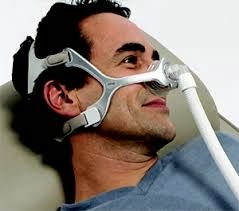
Masks range from nasal (as seen
here) to oral-nasal (also known as
full face masks) or nasal pillows.
You will meet with a specialist who handles PAP machines, masks and other devices. They will supply you with the devices you need and teach you how to use them (how to assemble the machine, hosing and mask; how to turn on the machine; how to fill the humidifier; how to assemble the mask; how to position the mask on your face and use its various features to adjust it) as well as how to clean and maintain all the parts. Then you basically go home and use your PAP.
Here is a typical setup: PAP machine
with humidifier basin, tubing, and
PAP mask with headgear

Generally, the systems today also include a chip (called an SD card, smart card or memory card) that records data from your machine for your physician to review. This is often, if not always, required by insurance companies to show proof you are "adhering to" or "complying with" treatment.  Some labs ask you to bring your chip in while others use equipment that remotely downloads it from your machine to their clinic for review. Insurance companies will not reimburse for PAP therapy over time if the patient fails to use it.


Insurance companies generally require at least 4 hours of use per night, at least 5 nights a week. You may have a bad week, followed by two good weeks, and still be more or less compliant. But the goal, ultimately, is to use it every night for every hour that you sleep. That way you guarantee your therapy will do what it's meant to do: keep your airway open so you can get the necessary oxygen your body needs to perform its many functions (all the way to the cellular level) as you rest.

So you receive your PAP setup, and you begin to use it. For many people, it's as simple as that. You start breathing again at night and you feel better over time. But for others, the challenge lies in adjusting to this new therapy. What might happen? You might:

Find it makes you feel like you are suffocating

Sometimes this is due to an incorrect pressure setting (too low) OR is the natural and temporary response to adjusting to pressure at first OR is the result of improper ramp settings. Give your PAP setup a week or two to allow yourself to adjust. If you still feel this way, ask your sleep specialist for advice. If you find it intolerable from Day One, don't wait two weeks; call them ASAP.

Feel like you are in a wind tunnel

Sometimes this is due to an incorrect pressure setting (too high) OR is the natural and temporary response to adjusting to pressure at first OR is the result of improper ramp settings. Give your PAP setup a week or two to allow yourself to adjust. If you still feel this way, ask your sleep specialist for advice.  If you find it intolerable from Day One, don't wait two weeks; call them ASAP.

Can you relate to this discussion?
Click to share your story!
Experience nasal dryness or irritation, or you wake up sneezing or have a bloody nose

You may need to adjust your heated humidity settings. Note: some older machines do not have heated humidity, while others may not have humidifiers at all. If you have an older machine, see your sleep specialist about getting a new one. You may also need to check to make sure you are adding enough distilled water to meet your nightly needs.

Encounter claustrophobia

This is separate from the experience of too much or too little pressure. Just having the mask on your face may make you feel claustrophobic, even without pressure. If you already suffer issues with anxiety, this could be a normal extension of that problem. Even if you aren't otherwise anxious, wearing a mask all night may still generate feelings of anxiety.

One way to eliminate this is to allow yourself opportunities throughout the day to wear the mask without the machine (such as while watching TV or knitting or reading in a chair or while lying down). The more you practice wearing it, the more "normal" it will come to feel. It is okay to slowly work your way into nightly use of your PAP therapy if claustrophobia is an issue. Aim for a couple of hours a night and add a little more each night if you can.

Insurance companies do honor an adjustment period (each company is different, but 30 to 90 consecutive days seems to be the norm). You need to achieve minimum compliance by the time established by the insurance company if you are to be reimbursed for your equipment.

If you still feel claustrophobic after a week, ask your sleep specialist for advice. If you find it intolerable from Day One,call them ASAP. You may have an opportunity to try on other masks to determine which might be more comfortable and create less anxiety for you.

Struggle to keep the mask on; either you pull it off at night or it comes off

Sometimes they come off. If you are a tosser-turner, even the most perfectly adjusted mask could come off. Some people discover they have taken the mask off themselves at some midpoint in the night, even tossing them onto the floor or the nightstand. That is part of adjustment behavior, too. Part of your brain is still giving you instructions even as you sleep. Just replace your mask and go back to sleep. Your brain will finally give in as you adjust. A mask that comes off now and again, while not doing you any service as a therapy, is not going to be a problem with compliance rates unless you don't put it back on again.
Soft headgear wraps like this one
can help to eliminate pressure marks

Have problems with skin irritation

You might find red lines or pressure marks on your face where the mask pressed against your skin. Generally, most of these marks are caused by the mask being overtightened. The masks are created to "seat" on your face in a way that seals lightly once the pressure is turned on. 

A small amount of incidental leakage is not going to interfere with your therapy compliance or leak values, so try not to worry too much about those numbers; your lab, if they are reviewing your numbers remotely, will decide when the leak is too high and work with you to make the proper adjustments. 

Some people use special face cremes marketed to work with masks, others use fabric linings to prevent moisture buildup. Ask your sleep specialist if these are right for you, keeping in mind that cremes may actually exacerbate skin irritation and linings, if not used correctly, may alter the effectiveness of your mask seal.

Wake up with excessive bloating or gas

Your sleep specialist will call this aerophagia, or air swallowing. It can come from mouth breathing, a common problem for people with obstructive sleep apnea. Often, oral breathers discover after a couple of weeks on PAP therapy that they no longer need to breathe through their mouth. The brain retrains itself to let the nasal passages do the work of inhaling and exhaling, which is the way we are all supposed to breathe. 
This is a chin support
you can easily attach to
your mask headgear
to cut down on oral
breathing at night.

This can be corrected by adding a soft chin support to your mask which helps to coax the mouth closed while your sleep. 

The full face or oral-nasal mask
covers both nose and mouth to allow
for uninterrupted breathing for those
who have deviated septum or struggle
to breathe well through their noses.
 
If you don't automatically return to nasal breathing after a couple of weeks on the mask and a chin support doesn't help, you may need to consider a mask that covers both the nose and mouth, which allows your jaw to drop open without any fear of breaking your mask seal.

You can also check your pressure settings to make sure they are correct, or ask your sleep specialist for help with this. Too much pressure can lead to air swallowing, too.

Be disturbed by noise that comes from your mask or machine

Today's machines are practically silent, so if yours is not, you may think about trading it in for a new model. Some people, incidentally, prefer the white noise emissions of the older PAP machines, so this may actually be a blessing for some.

If your mask makes funny burping or whistling sounds, it's a sign that it's not positioned correctly or it could be over- or under-tightened. Play around with the fit until it goes silent again. If this doesn't happen, get advice from your sleep specialist about fitting or potentially trying out a new mask.

Masks these days are getting lighter and smarter, with less parts and a closer, easier fit. You may simply need to update yours.

Have a bed partner who does not appreciate the value of your therapy

Editor's note: Hmm. Not sure what they
mean when they say CPAP isn't sexy.
I'm pretty sure this is designer
Zac Posen's doppelganger rocking
a nasal PAP mask.
This is a much bigger problem than it should be. Your need for PAP therapy is no less important than your need for any other prescriptive treatment (such as an asthma inhaler or an insulin injection system).

Without PAP therapy, you put your entire body at risk for many other chronic problems; if you already have heart disease, diabetes or respiratory problems like COPD, PAP therapy may indeed save your life.

If your bed partner tends to complain about your therapy, have them attend your visit to your sleep specialist so they can be versed on the critical value of maintaining compliant PAP therapy for their continued health. Adequate breathing and oxygen during sleep is not an optional, cosmetic problem; it is a function of optimal health and, without it, has been proven to lead to lower mortality by all the major chronic diseases that plague our society. 

If it's the noise of the machine that bothers them, consider trading in your old model for a newer more quiet one or have your bed partner try wearing earplugs or use a white noise machine to offset the sound.

If it's the appearance of the mask, or the presence of the tubing, they need to understand how and why the therapy works and that for the vast majority of the night, they will be asleep and won't even see the mask or notice the hosing. The mask is only used during sleep and not for any other romantic bedtime activities, after all.

Wear the mask comfortably and dutifully only to discover the data download says your mask has high leak values

Usually the sleep specialist will contact you about this and have you come in to review mask fitting practices and to determine whether a different mask might be better for you. Ultra high leak values (as determined by each mask manufacturer based on their own pressure settings) are something that the lab should be watching out for and addressing as they happen.
Sometimes, problems with PAP are more general and are related to using worn-out equipment (for long-time users) or practicing poor cleaning and maintenance habits on newer users. To learn more about how to generally care for your PAP setup, check out this guest post by sleep technologist and respiratory therapist Rui de Sousa.

Here's one of the latest new ways to defend against obstructive apnea:
The Inspire device, which stimulates the nerves that operate in the
upper airway to prevent its collapse. It is an implant device that
requires a surgical procedure and followup, but it could be a lifesaver
for those who have tried other treatments and failed to comply. 
Despite all this advice, many patients become frustrated and decide that PAP doesn't matter. They give up and never go back to their sleep specialist. This could be you or a family member or other loved one in your life. You always have the choice to refuse treatment, but at what peril? Learn what happens if you don't treat sleep apnea.

Or, you may be all for treating your sleep apnea, but the PAP setup, after a very concerted effort, just does not seem to be working for you.

Though PAP is the gold standard for treating sleep apnea, there are other therapies for sleep apnea that don't involve a mask. 

Often, trying a new therapy is a good alternative; or, these alternatives may leave you wanting to return to PAP.

In either case, you are better informed on all your options with any medical treatment so that you can make the decision that is best for you.

18 October 2014

CPAP Central || A Season for Masks || Smaller Might Be Better

Respironics Go Life nasal pillows are easy to adjust and designed
to handle both CPAP and BiPAP prescriptions.
People often think that, once diagnosed with apnea and in need of PAP equipment, they will be limited to something more akin to a hockey mask than to what is actually available. Believe it or not, not all positive airway pressure (PAP) systems require a large mask.
Philips Respironics Nuance Nasal Gel Pillow employs comfort
gel technology with the same ultra-soft materials used in NICU
units to provide a super soft headgear that doesn't irritate skin. 

If you have been given a prescription for CPAP, BiPAP or AutoPAP, you need to check with your physician to see if you can opt for one of the smaller masks available. Note: Not everyone can wear a smaller mask due to facial physiology, facial hair or the amount of pressure necessary for PAP to be successful... but if you have a lower pressure and your facial landscape can support a smaller mask, it might be worth looking into. So go ahead and ask!

There are two main varieties of PAP masks which come in smaller shapes and sizes, often with minimal headgear as well.

NASAL PILLOWS 

These small devices aren't technically masks, but small pressure delivery devices which reside right inside your nostrils. For people who do not like the feeling of headgear on the face and scalp, these can be a good option as they offer minimal fitting with headgear.

ResMed claims its AirFit™ P10
Nasal Pillow is one of the quietest
pillow PAP delivery systems
available on the market.
The ResMed Swift FX for Her
has soft headgear and a smaller
pillow design for the female face.
The ResMed Mirage Swift Nasal
Pillow has a unique barrel-
shaped pillow design.

Nasal pillows may require some adjustment to the direct delivery of air pressure through your nostrils, as you cannot get a good return on this form of mask if you normally breathe through your mouth. Often noted in early use of nasal pillows during the initial adjustment period is a feeling of "not being able to breathe out against the incoming air." This is easily addressed, as PAP machines have special settings which can be adjusted to help with exhale pressures while using nasal pillows.

NASAL MASKS

The Respironics Wisp stays put with light, supportive
headgear. It easily detaches from the tubing for quick
trips to the bathroom at night. You can also hook the tubing
into the top of the headgear to redirect it toward your
headboard to reduce tangling with it.
ResMed's Swift Nano nasal
mask is very lightweight
and adjusts to different
nose bridge lengths. It comes
with minimal headgear.
These are smaller, more lightweight versions of the classic masks that most people associate with PAP therapy.

The Mirage FX by ResMed is small,
stable and fits to most facial features.
It has a great reputation for
preventing leaks, too.
Many people who have been on PAP therapy for years may not even know they have some options now that include fixing the tubing up and over the head for better sight lines and less tangling, as well as softer or, in some cases, minimal headgear. Many of these newer masks are very effective in keeping down leak and staying put and can make all the difference if comfort with a larger mask is an issue.


CHIN SUPPORTS 
A chin support can help draw the jaw shut
until you relearn to breathe only through your
nose while using PAP therapy, which is how
you should breathe naturally.
Those who breathe through their mouth may try using smaller mask options if they are willing to also use a chin support device in order to preserve the pressure therapy they have been prescribed. Chin supports help keep the jaw aligned and prevent the mouth from opening and breaking the critical pressure seal that is the key feature of PAP therapy.