Following his post below are further updates I was able to gather from this week's special session on this topic held at the Association of Professional Sleep Societies meeting held in Seattle.

Rui de Sousa is a Canadian sleep technologist with over 20 years experience helping patients sleep better in and around the greater Toronto area. Rui is also heavily involved in educating new sleep technologists and the public, for whom he has presented educational forums. Rui has published several chapters in a medical textbook, articles in local newspapers, and has been interviewed on TV and on the radio. He also keeps abreast of the latest knowledge, techniques and technologies attending local and international conferences. He was recently in attendance at the Seattle SLEEP2015 event where the subject of the ASV/BiPAP device restrictions was discussed in special session. _____________________________________
Insights into the recent ASV device recall
Most of you have heard of Obstructive Sleep Apnea (OSA). You know, when you stop breathing in your sleep because the airway becomes obstructed. The best way to treat this condition, at this time, is the Positive Airway Pressure, or PAP machine. Continuous Positive Airway Pressure, or CPAP, is the most common form of this therapy. It is the machine that connects to a mask which blows air at one steady pressure into your airway to keep it from collapsing. Another variant of PAP is the BiLevel PAP (BiPAP), which blows air at two different pressures, one when you inhale, and a lower pressure when you exhale. What many of you haven't heard of is Central Sleep Apnea (CSA). What exactly is it? With CSA, the airway is wide open, but your brain fails to signal to your lungs and diaphragm to breathe while you are asleep. The drive to breathe is gone; in essence, you are just holding your breath. The reasons why people may suffer from CSA are varied, but basically they fall into two camps: Neurological (the brain is the cause) and cardiological (the heart is the cause).
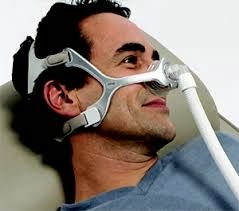
Both CPAP nor BiPAP are very effective in treating OSA, but not with CSA, because the openness of the airway is not at issue for CSA. But fear not, people much smarter than I have come up with ingenious machines to help that much smaller population who struggle with CSA. These devices, introduced in 2005, may look like regular CPAP machines and masks, but they work much differently. Known as the Adaptive Servo-Ventilator (ASV – by ResMed) or the BiPAP AutoSV (or BiPAP AutoSV Advanced) by Respironics, these machines use complex algorithms that adapt to the way you normally breathe, and try to mimic that when you are asleep, even when your body falters in sending or receiving the signals to breathe.
Does it work? Surprisingly, it works rather well. These machines are indeed a huge step forward in the way we treat more complicated cases of sleep apnea not caused by obstructions. Even better, technologists have adjusted the algorithms for these therapies to target different diseases where CSA is a symptom, such as ALS (aka Lou Gehrig's Disease) and Chronic Obstructive Pulmonary Disease (COPD).
OK! Great News... so what's the problem?
One of the target populations for this new generation of PAP therapy includes patients with heart failure. Heart disease can be a cause of CSA, and the ASV/BiPAP AutoSV technologies have been widely used in these patients to treat, reduce and even eliminate their apneas.
 However, in early May 2015, the SERVE-HF--a multinational, multicenter, randomized controlled Phase IV study (fancy words for a large and important study)--showed that for a specific sub-population of people who are in heart failure, ASV/BiPAP AutoSV therapies are actually doing more harm than good. Specifically, they identified those people with symptomatic chronic heart failure (LVEF* of less than or equal to 45%) as being at higher risk for death while using these therapies, even though their apneas may actually be eliminated or controlled.
Right now, the researchers are unclear why this is happening. Many smart researchers and doctors are working hard to understand whether the machine itself is causing the problem, or whether the actual apneas are somehow a protective mechanism within these patients, or whether it is something else entirely.
As soon as word of the study results reached the manufacturers of these devices, both international companies recalled their use in those cases where patients using them belong to this very specific population: of people with symptomatic chronic heart failure. By no means does this suggest that all PAP therapies are dangerous, because the others are completely safe and effective and they have not been recalled for anybody. It is specifically the ASV/BiPAP AutoSV therapy model and the chronic heart disease patient who are affected by this change. Please continue to use your CPAP or BiPAP machine as prescribed, and if you are using an ASV/BiPAP AutoSV device, please contact your doctor immediately to confirm you should still be using it. Chances are, if you are an active user who belongs to the at-risk group, you have already been contacted by your physician. But if you haven't, and you are the least bit concerned, don't hesitate to make the phone call to confirm your prescription protocol. The best protection against fear is knowledge and facts. The CPAP is still the “gold standard” in treating OSA. The ASV/BiPAP AutoSV are still extremely valuable tools in treating CSA. If you have any concerns, please have them answered by a knowledgeable and competent professional. *Left Ventricular Ejection Fraction: Left ventricular ejection fraction (LVEF) is the measurement of how much blood is being pumped out of the left ventricle of the heart (the main pumping chamber) with each contraction. -- Definition from the Cleveland Clinic
_____________________________________

UPDATES FROM THE CURATOR At this week's SLEEP 2015 meeting in Seattle, which hosts three separate organizations (Sleep Research Society, American Academy of Sleep Medicine, and the American Association of Sleep Technologists), a special session devoted to this discussion, "ASV Therapy for CSA Patients with Heart Failure: SERVE-HF Results," took place on Monday June 8 and featured sleep activist and physician Dr. Timothy Morgenthaler of the Mayo Clinic and Dr. Glenn Richard, Chief Medical Officer for ResMed. Here are some additional details I was able to cull from that conversation.
- The SERVE-HF study itself is not published; therefore, there are actually no conclusive results to share publicly about this latest finding. Many outstanding questions remain and the researchers involved are going over every detail to try to understand these recent (and unexpected) outcomes. They will put together their findings as soon as they are able.
Some history: It was deemed by mid-April that the study should be closed due to proven risk factors encountered in overviews of the study's raw data. The plan initially was for the results of SERVE-HF to be released formally in September. However, in mid-May, the American Academy of Sleep Medicine and the American Thoracic Society, in cooperation with ResMed, acted promptly by supporting the Field Safety Notice released by ResMed, as described above.
Patient safety is a concern for all involved and expands to include Respironics, ResMed's technological competitor, who will also actively engage in review of the data from the SERVE-HF study to determine why the ASV/BiPAP AutoSV devices may be putting a very specific population group at risk. - It is important to note that the people for whom this technology is most risky comprise a very small, specific population.
• Patients have severe ventricular dysfunction. • Patients had measurable LVEF of less than or equal to 45%. • Patients belonged to a category of cardiac disease severity: NYHA class III or IV - Discontinuing use of ASV is ultimately a decision best left up to the patient and their doctor. Some patients who fit this very specific criteria are still continuing to use ASV because they have seen notable improvements in their health and feel it is worth the risk to continue. ASV has been delisted as a "standard" protocol for treatment for this particular population of patients and is now being listed as a "guideline" "in the absence of more reliable data" (Morganthaler). It is important for doctors to disclose to patients their potential for harm by using this device and to discuss further use of this therapy. Patients will likely need to sign additional documents verifying they fully understand their risks before continuing to use ASV/BiPAP AutoSV.
- Initial safety of these devices was approved based on short-term primary outcome measures at a time when long-term outcome data were not yet available. The SERVE-HF represents one of the first long-term studies.
- The main question that was spawned from this study, "Why this result?" has, currently, the following as possible answers: a. There could be occult confounding variables. In layman's terms, that means there might be other factors not measured during the study, such as patient medication use compliance or something else yet to be discovered, that could have contributed to this outcome. b. ASV may not be a good therapy for these patients specifically because it could dampen signals connecting cardiac activity to the brain and the respiratory system. Only further research will be able to determine whether this is true. c. Maybe the abnormal respiratory patterns associated with CSA--Cheyne-Stokes Respiration--are actually positive mechanisms for these patients.
- Other options for patients in this category who are currently on ASV can include the following: a. CPAP + oxygen therapy b. Stand-alone Oxygen therapy
- The final takeaway: As with all medications, all therapies, including mechanical one likes ASV/BiPAP AutoSV, are NEVER risk-free. It is up to the patient, ultimately, to ask the doctor to clarify the risk-benefit ratio first in order to decide whether to start, to continue or to discontinue any kind of therapy, including this one. Be an informed patient; ask your doctor for all the details and make your medical decisions based on all the information available to you.